Karst Groundwater as Community Water Sources
Evaluation of Untreated Karst Groundwater as Community Water Sources, Barren and Monroe Counties, KY
A project completed with US Geological Survey104b grant funding provided through the Kentucky Water Resources Research Institute. This water quality study evaluated groundwater derived from karst features, used as a source of untreated drinking water for several communities in south-central Kentucky. It is known that groundwater in karst geologic settings is particularly vulnerable to contamination. Much of Kentucky has well-developed karst aquifer/landscape systems. As agriculture in the region can introduce contaminants to groundwater including fecal bacteria, pesticides, and fertilizers, the use of untreated karst water supplies in Kentucky has been largely eliminated. However, there are still communities that rely on such water and this may represent underappreciated, if local, public health threats. Residents of plain living communities in several southcentral Kentucky counties rely on karst springs and cave water with limited, individual treatment strategies, and in some cases, none. There are various perceptions of water safety. The hydrogeologic, water quality, social and economic conditions in this part of southcentral Kentucky may serve as a model for understanding other similar water supply challenges in Kentucky’s rural karst areas.
Objectives
The immediate objectives of the project were to 1) conduct a year-long, synoptic water sampling campaign for raw water at three karst springs used currently or formerly for family water supplies to develop objective data to use as examples when discussing the risks of using such water untreated, and 2) to test water (also over one year) from one of the springs that had been treated with a home reverse-osmosis filtering system, to see whether this simple and relatively inexpensive system is an effective tool for safely treating these water sources, 3) to begin to develop relationships with families and other relevant stakeholders, and to understand the range of various technology-impacting lifestyle choices in these communities to inform a strategy for designing solutions water supply challenges.
Scope of Work
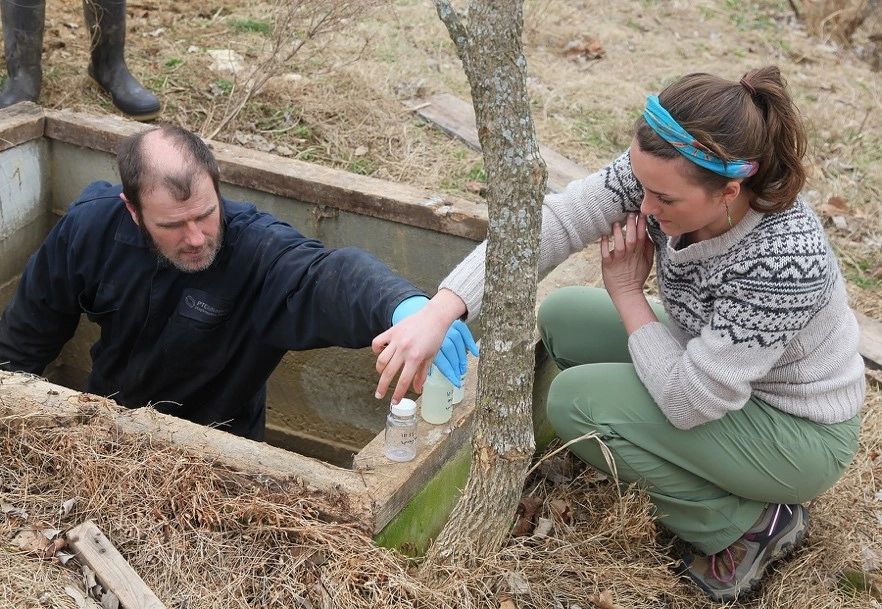
Water samples were collected to sample for fecal bacteria including total coliforms and Escherichia coli (E. coli), turbidity, nitrate (NO3-) and ammonia (NH4+).
Conclusions and Future Work
Analysis showed that all untreated water was positive for both total coliforms (ranging from 436 colonies per 100 mL to over 2,420--the largest number that can be quantified without dilution) and E. coli (ranging from 2 to 920 colonies). This indicates that according to World Health Organization guidelines every sample of non-treated water was polluted with respect to water quality and had high gastrointestinal (GI) health risk. When presented with this information, one family installed a reverse osmosis system and although this system was relatively inexpensive (currently <$500) and simple, overall it performed well. No E. coli was detected in any filtered sample, and other than two samples of single-digit total coliforms (2 and 5 colonies respectively) only one sample was high (133) and the rest were negative.
Nitrate was also present in all samples ranging from about 12 mg/L (reported as NO3-) to about 42 mg/L in raw spring water, and levels at the spring were reduced by the filter system by about 50 to more than 80%. No samples were above the US Environmental Protection Agency’s Maximum Contaminant Level (MCL) of 62 parts per million when reported as NO3-.
Our team also made good progress in learning about these communities, and met members of another nearby community in which several homes and a church are supplied by a karst spring. We were able to sample the raw and treated water at one home for fecal bacteria and while the raw water was positive both for total coliforms and E. coli (132 and 2 colonies per 100 mL, respectively) the in-home filter system worked well and water was negative for both.
Perhaps most importantly we gained significant experience in the communities in learning about the relationships between water quality and quantity, lifestyle choices, and the potential health risks associated with these water sources.Going forward we hope to sample raw groundwater used for drinking among other users, determine what treatment systems they use (if any), and whether they work, to continue to better understand solutions for places where treatment may not currently be used.